HMRC offers options on undeclared wealth

HMRC is offering taxpayers named in the leaked Pandora Papers a chance to correct their tax affairs. The October 2021 leak involved almost 12 million documents revealing hidden wealth and tax avoidance.

The papers revealed that many taxpayers had used shell companies to hold luxury items such as property and yachts.

HMRC has reviewed the papers and found UK residents who they believe have untaxed offshore assets. They are now warning those taxpayers that they might face penalties of up to 200% on the tax due, and there is also the possibility of prosecution.

Disclosure

There are two alternatives for taxpayers who wish to disclose tax due on undeclared overseas income or gains:

  • The Worldwide Disclosure Facility: This can be used by anyone who wants to disclose a UK tax liability that relates wholly or partly to an offshore issue. With this alternative, there is no protection from prosecution if, for example, there has been tax evasion.
  • The Contractual Disclosure Facility: This can only be used to admit to tax fraud, and not other types of disclosure. HMRC will agree not to criminally investigate, so this is the best option where there is dishonesty or fraud.

Voluntary disclosure may help mitigate penalties due, and also provide some measure of control over the process.

Receipt of a letter

Anyone who receives a letter from HMRC should review their tax position, and, if disclosure is required, take immediate steps to correct the situation. Given the complexity of overseas tax matters, professional advice is recommended.

The Pandora Papers is the third major leak of financial information, and with HMRC having 12 years to investigate offshore non-compliance, it should serve as a timely reminder to taxpayers who fail to declare and pay tax on overseas income and gains and think that HMRC will never find out.

HMRC’s press release on giving offshore taxpayers a chance to come clean, along with links to disclosure options, can be found here.

Photo by Noel Nichols on Unsplash

Let’s talk about the National insurance gap extension

The normal time limit for a person to fill gaps in their national insurance (NI) record is six years, but transitional arrangements allow gaps to be filled back to 2006/07. The deadline for making such contributions was recently extended to 31 July 2023, but has now been extended to 5 April 2025.

The deadline has been delayed because people have been finding it difficult to get through on pension helplines once the July deadline received a publicity boost. The transitional arrangement will now apply for the years 2006/07 to 2017/18.

Voluntary NI contributions for the years 2006/07 to 2017/18 paid by 5 April 2025 will be at the 2022/23 rate of £15.85 a week, even though the rate is currently £17.45.

Contribution record

The first step is for a person to check their state pension forecast and NI record. This can easily be done online.

  • Voluntary contributions will not always increase the amount of state pension. The decision can be especially complex if contracted out of the state pension prior to 2016.
  • A person in very poor health or with a short life expectancy will probably not benefit from voluntary contributions.

Personalised advice can be obtained by contacting the Future Pension Centre (if not yet at state pension age) or the Pension Service (if already receiving the state pension).

The benefit

A person needs 35 qualifying years on their NI record to qualify for the full state pension, which is currently £10,600 a year. To add a full year the cost is £824, but this will boost annual pension entitlement by some £303 – a very respectable return for someone who then enjoys at least five years of retirement.

The return will be even better if partially complete years can be filled since these might only require a few missing weeks – at £15.85 per week – to be paid.

A state pension forecast can be obtained here.

Photo by Diana Parkhouse on Unsplash

Increase in number of estates paying IHT

The combination of a frozen inheritance tax (IHT) nil rate band and considerably higher property values has pushed more estates into the IHT net. The average IHT bill is now nearly £62,000, with much larger amounts payable if an estate includes a property in London or the South East.

Increase in property values

Even though property prices have fallen recently, the average price of a detached house went up by more than £20,000 to nearly £454,000 during the year to March 2023. The average price for London property is not far off £525,000.

  • Since the nil rate band was frozen back in 2009, the average UK property has risen in value by 86%.
  • The FTSE All Share index shows an even better return, having gone up by just under 245%. An investment of £50,000 in March 2009 would have been worth over £170,000 by March 2023.

With cash savings also added in, a typical estate is now valued at just under £480,000. If the residence nil rate band is not available, the IHT liability on such an estate is £62,000. However, if the nil rate band had been uprated with inflation, no IHT would have been payable on such an estate.

Mitigating IHT liability

Mitigating a future IHT liability requires a shift from being a saver to a spender. This might mean putting assets into trust or making pension contributions – financial advice being essential here.

Making lifetime gifts will obviously reduce the value of an estate. Options could include regular monthly saving into junior ISAs for grandchildren (with such gifts normally completely free of IHT) or helping a child with their first home by paying the deposit (such a large gift will exceed the available exemptions but will fall out of IHT after seven years).

Even if you decide to just spend on yourself, leasing a new car or taking extended holidays abroad looks much more affordable if you factor in the future 40% IHT reduction.

HMRC’s basic guide to how IHT works, including details of various exemptions, can be found here.

Photo by Joel Moysuh on Unsplash

First time buyers: time to act?

The increased stamp duty relief for first time buyers has not been reversed by the new Chancellor, but it may not survive beyond the tax year.

One of the few tax cuts to survive from Chancellor Kwarteng’s September’s Growth Plan is the uplift to stamp duty land tax (SDLT) relief for first time buyers. This has gone up from £300,000 to £425,000, potentially saving qualifying first-time buyers up to £8,750.

The current SDLT nil-rate threshold for property purchases in England and Northern Ireland is £250,000, but first-time buyers now benefit from an enhanced threshold of £425,000. The additional £175,000 of nil-rate threshold saves SDLT at the rate of 5%.

In Wales the starting threshold for main residential Land Transaction Tax was lifted from £180,000 to £225,00 from 10 October, which should also help first time buyers. Scotland has not yet made any changes to land taxes.

Eligible properties – mind the gap

The maximum eligible property value in England and Northern Ireland has also been increased from £500,000 to £625,000.

  • If a property costs between £425,000 and £625,000, SDLT (at the rate of 5%) is paid only on the excess over £425,000.
  • However, where the cost of a property exceeds £625,000, normal rates of SDLT are paid on the full purchase price
  • This means there will be quite a jump in the amount of SDLT if a first-time buyer just exceeds the £625,000 limit. For example, SDLT on a property purchased for £625,000 is £10,000, but goes up to £18,800 if the purchase price is merely £1,000 higher.

Eligible buyers

To qualify as a first time buyer, the individual must never have owned a freehold or leasehold interest in a residential property in the UK or anywhere else in the world. They must also intend to occupy the property as their main residence.

This can be problematic for joint purchasers, since all purchasers have to meet the qualifying conditions. First time buyer relief therefore does not generally apply if a parent helps their son or daughter get a foot on the property ladder by taking out a joint mortgage with them, if this also means joint ownership.

It would be no surprise if these SDLT relief increases are partly or fully reversed in April 2023. First time buyers planning to purchase a home in the near future might be advised to do so sooner rather than later to take advantage of this relief before it disappears – the relevant date is the point of completion.

To work out how much you could pay or save, see the Government’s online SDLT calculator, which will work for most types of property purchase.

Photo by Tierra Mallorca on Unsplash


Confused on claiming residence band relief?

Working through inheritance tax (IHT) requirements come at a difficult time. The provisions of the residence nil rate band (RNRB), which can be passed on between deceased spouses and civil partners, has caused some confusion.

Any unused RNRB from the first death of a spouse or partner can be relieved on the death of the second individual. The claim is based on the value of the RNRB at second death, but some executors are mistakenly using the value at the date of first death.

The RNRB was introduced from 6 April 2017 at £100,000, increasing by £25,000 a year until reaching its current value of £175,000.

The claim for RNRB is made on IHT form IHT436, with the confusion coming from the entry at box 11: the value of the RNRB enhancement at the spouse or civil partner’s date of death. However, the actual claim is based on the value entered at box 14. This should be the value of the RNRB at the date of second death, although it is easy to see why mistakes are being made given the confusing wording used by HMRC.

HMRC does not seem to be picking up the error, so if a mistake has been made a correction will have to be made by writing to the Revenue.

Conditions and transfer

Unlike the normal IHT nil rate band, the RNRB comes with various conditions. It is only available:

  • At death (not against lifetime gifts).
  • Against the value of a home (only one property can qualify).
  • Where the home is inherited by direct descendants (including step, adopted and foster children).

Any unused RNRB can be transferred in the same way as the nil rate band, with a claim required within two years of second death. It doesn’t matter if first death was before the introduction of the RNRB on 6 April 2017.

The unused RNRB of more than one spouse or civil partner can be transferred, but the overall total cannot exceed one full RNRB (£175,000).

Detailed HMRC guidance on working out and applying the RNRB can be found here.

Photo by Joel Moysuh on Unsplash


Tax implications of no fault divorce

No fault divorce became a reality in April this year. Although it brought no associated changes to the tax rules, divorcing couples should now be in a better position to focus on financial issues – particularly important if not using a lawyer or solicitor.

Capital gains tax

For most couples, the main tax issue will be the capital gains tax (CGT) consequences of transferring assets as part of the divorce settlement.

The basic rule is that transfers only escape CGT (on a ‘no gain, no loss’ basis) if made by the end of the tax year in which the couple are no longer living together – the year of separation.

After the end of the year of separation, but before the divorce is finalised, any transfers of assets will be treated as made at market value, so CGT can be payable – but with no proceeds to fund the tax liability.

Couples dissolving a civil partnership can now also do so on the same no fault basis.

Private residence relief will generally mean there are no – or few – CGT implications if transferring the family home, but someone with a portfolio of property and investments could face a large, unnecessary, CGT bill without careful planning.

Timing

With a no fault divorce, the applicant is required to wait 20 weeks from the start of the divorce proceedings until a Conditional Order (previously the Decree Nisi) is made. This is the time for reaching a financial agreement on how assets are to be divided. There is then a further wait of six weeks until the Final Order (previously the Decree Absolute) can be made.

This is a minimum of six months. Add on possible paperwork processing delays, and a separation in the second half of the tax year means a straightforward transfer of assets will not be possible until the next tax year, making CGT an issue.

HMRC has provided an updated help-sheet on the CGT implications of divorce, dissolution and separation here. During such a stressful process, it’s more important than ever to ensure you have the right expert guidance, so let us know if we can help.

Photo by Mathieu Stern on Unsplash

Sharp rise in higher rate taxpayer numbers…….

……and if that’s you, then advice is now more important than ever.

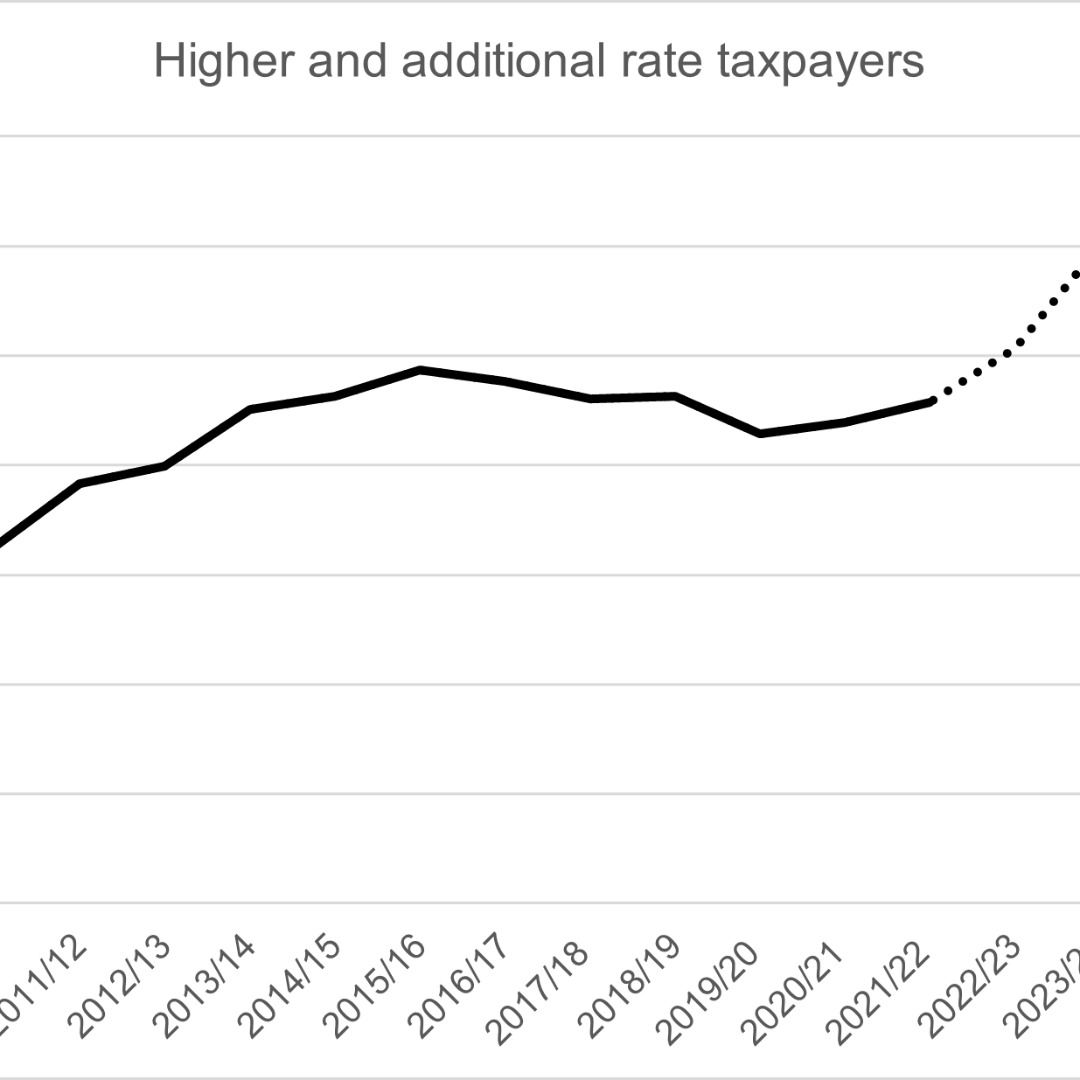
There was once a time when paying tax at more than the basic rate made you a member of a somewhat select club. In 2010/11, the first year in which additional rate tax was introduced, the proportion of taxpayers who were taxed at more than the basic rate was 10.4%.

Five years later, a dose of austerity pushed the figure close to 16%. Then it began to drop as higher rate thresholds were raised, so that by 2019/20 it was down to 13.6%. From that low, the upward path was resumed.

Alongside the Chancellor’s Spring Statement in March, the Office for Budget Responsibility (OBR) issued estimates that the freeze in the personal allowance and, outside Scotland, and basic rate bands through to 2025/26 will mean by that year almost 19% of taxpayers will be liable for higher rate tax.

The number of taxpayers will also be increasing too because of the personal allowance staying at £12,570. The rising taxpayer numbers explain why the Chancellor could announce a 1p cut in basic rate tax in 2024/25 at the same time as the OBR calculated that income tax revenue for the year would increase by £12 billion. Scotland already has a starter rate of 19%.

If your head is spinning from all the numbers, there is a simple message you: you are likely to pass more of your income to HMRC in the coming years. To limit just how much extra the Exchequer gains and you lose, there are plenty of actions to consider wherever you are in the UK:

  • If you are married or in a civil partnership, make sure you are maximising the benefits of independent tax and, if you are eligible, claiming the transferable marriage allowance.
  • Check your PAYE code – it could be wrong.
  • Ensure you are claiming full tax relief on the pension contributions you make. Do not assume this will be given automatically, especially if you pay higher rate tax.
  • Consider an ISA first for any investment as it is free from UK income tax and capital gains tax.
  • Choose any employee perks with care. Some are highly tax efficient, while others carry a heavy tax burden.

Remember that if you are or likely to become a member of the ever-expanding higher rate taxpayer club, the value of taking independent financial advice rises with your tax rate.

Source: ONS data, OBR projections.

Cryptoassets tax confusion

HMRC is sending letters to taxpayers who they believe hold cryptoassets, advising them of the potential capital gains tax (CGT) implications and linking to relevant guidance. Many taxpayers will be unaware that simply exchanging one type of token for another is a disposal for CGT purposes.

It is estimated that more than two million people in the UK hold cryptoassets. Although certain transactions will be taxed as income, most are subject to CGT.

HMRC is particularly concerned that people wrongly believe their crypto transactions to be tax free. The buying and selling of crypto assets is not considered to be the same as gambling.

What is a disposal?

There is a CGT disposal if you:

  • Sell tokens (even if the proceeds are not withdrawn from the exchange);
  • Exchange one type of token for a different type of token;
  • Use tokens to pay for goods or services; or
  • Make a gift of your tokens to another person (unless it’s to your spouse or civil partner).

There is no disposal if, for example, you simply move tokens between different wallets.

CGT treatment

For CGT purposes, tokens are treated similarly to shares, so each type of token is pooled.

If tokens are exchanged, an appropriate exchange rate must be established in order to convert the transaction to pound sterling. With more than a few transactions, things can easily become complicated. Software is available to help work out your tax bill.

Example

An investor purchases a new token using some of their Ether tokens. The new token increases in value, so the investor converts the new token back to Ether. Both transactions are disposals, so CGT will be due if the £12,300 annual exemption is exceeded. There may be no funds to pay this bill, but any further sale of Ether to realise cash will be another disposal, meaning more tax.

The guidance highlighted in HMRC’s letters, which was set out three years ago, can be found here.

Photo by Executium on Unsplash

Treasury sets aside CGT and IHT change agendas

Tax and Administration Maintenance (TAM) Day is a new phenomenon brought in by the Treasury to try and move away from the traditional all-in-one Budget. Following the first ‘Tax Day’ in March, the end of November saw another round of announcements.

The government set out steps to modernise and simplify the UK tax system, but of more interest is the response to the Office of Tax Simplification’s (OTS) reviews into inheritance tax (IHT) and capital gains tax (CGT).

Inheritance tax

The review into IHT had made various recommendations, particularly regarding exemptions and reliefs as these can be quite complicated. Given that the nil rate band and the residence nil rate band are frozen until 2025/26, the government has decided not to proceed with any IHT changes for the time being, although the door has been left open for changes in the future.

Reduced IHT reporting requirements from 1 January 2022 have already been announced, and the latest confirmation of the status quo will be welcomed by anyone who has recently undertaken IHT planning.

Capital gains tax

Wide ranging and more radical OTS suggestions on CGT, such as aligning the rate of CGT with income tax rates and significantly reducing the amount of the annual exemption, have been put on hold for now.

The time limit for reporting and paying CGT in respect of residential property disposals has already been extended from 30 days to 60 days. Other measures that the government intends to go ahead with include:

  • Integrating the different ways of reporting and paying CGT into a single customer account;
  • Extending the no gain, no loss window on separation and divorce; and
  • Relaxing the rollover relief conditions where land and buildings are acquired under a compulsory purchase order.

Although less definite than the above, the government will also review principal residence relief nominations and the rules for enterprise investment schemes; however, any changes are expected to be merely procedural in nature.

Details of the government’s response to both of the OTS’s reviews can be found here.

Photo by Tim Hüfner on Unsplash

Are your young adults missing out on their Child Trust Fund?

HMRC says many teenagers are missing out on their Child Trust Funds (CTFs), urging parents to check for hidden cash and forgotten accounts.

The first CTFs matured just over a year ago, at the start of September 2020. CTFs will continue to mature until January 2029 as their owners reach the magic age of 18. At present, about 55,000 CTFs mature every month.

HMRC has been looking at the CTFs that have already matured. Its interest is more than academic because over the life of the scheme, HMRC set up one million CTFs – about 15% of the total. HMRC took the CTF establishment role when parents or guardians had failed to do so within 12 months of receiving a CTF government voucher. HMRC randomly allocated an approved CTF provider to each such orphan.

In a recent press release, HMRC said “Hundreds of thousands of accounts have been claimed so far, but many have not”. Annoyingly – and perhaps deliberately – HMRC does not spell out specific numbers of non-claimants, but said if only 10% miss the date, that amounts to over 5,000 a month.

It should come as no surprise that many parents, guardians and children have forgotten that a CTF exists. To judge by data issued earlier this year, over 80% of CTFs are worth less than £2,500, with many probably only valued in the hundreds, having received no more than one voucher of £250 or £500 before government payments ceased.

If you want to find a ‘lost’ CTF, the best starting point is HMRC’s online tool (see https://www.gov.uk/child-trust-funds/find-a-child-trust-fund). To use this, you will need to create a Government Gateway user ID and password if you do not already have one.

CTFs that carry on beyond their owner’s 18th birthday continue to offer the same tax benefits as ISAs – no UK tax on income or capital gains. However, the underlying investments may be unattractive – deposits with minimal interest rates, for example. The same investment drawbacks can apply long before maturity, so it is worth reviewing any existing CTFs. A transfer to a Junior ISA (JISA) could be a better option than carrying on with a CTF.

Photo by Annie Spratt on Unsplash