The Ofgem price cap returns

From 1 July, the energy price cap set by energy regulator, Ofgem, will fall from £3,280 to £2,074. Prices are currently capped at £2,500, but this further reduction will help home-based employees and any small business owners who work out of residential accommodation.

In October last year, the government introduced a temporary energy price guarantee that has limited the annual gas and electricity costs for a typical household. This cap was set to increase from £2,500 to £3,000 this July, however, the lower energy price cap of £2,074 will now apply instead.

Impact of the cap

The energy price cap is set quarterly, so the limit of £2,074 will apply from 1 July to 30 September 2023.

  • Customers on standard variable tariffs with typical consumption will see their bills fall in line with the cut in prices.
  • However, annual bills are not capped as such. Households with higher energy use will pay more than the cap, with lower energy users paying less.

The £3,000 energy price guarantee will remain in place as a safety net until 31 March 2024 just in case energy prices increase above this level.

Even with the price reduction from 1 July, energy prices will still be almost double what they were before costs started to soar.

Fixed energy deals

There are virtually no fixed energy deals currently available, although they might return now that prices have started to fall.

The energy price cap is forecast to remain around £2,000 until March 2024, so any fixed rate deal must be compared to this rate. A fixed rate deal will provide certainty, but the downside is being locked in for a fixed term should prices fall. An exit fee – which can be quite substantial ­– is normally charged to end a fixed deal early.

A government briefing of the energy price guarantee and how it operates alongside the energy price cap can be found here.

Photo by Firmbee.com on Unsplash

2023/24 – the 23-month tax year?

If you are self-employed, the new tax year may be longer than you think.

If you are self-employed, until 2023/24, you have normally been taxed on the profits made in the accounting year that ends in the tax year. For example, if your accounting year ran to 30 April, then in the last tax year, 2022/23, you are taxed on the profits for your accounting year ending on 30 April 2022 – a few weeks after the start of the tax year.

Some while ago, the government decided that it would speed matters up by forcing all the self-employed (including partners in partnerships) to pay tax on the profits earned in the tax year. As is obvious from the example above, moving from the accounting year system to a tax year one implies a catch-up exercise that theoretically results in more than 12 months’ profits being taxed in a single tax year.

Unless your accounting year ends on 31 March or 5 April, that is what will start happening in this tax year. Taking the 30 April year end again, in 2023/24 the default position will be that your taxable profits are:

  • The “normal” calculation of profits for the accounting year ending 30 April 2023, plus
  • One fifth of a catch-up element equal to:
    • Your profits from 1 May 2023 to 5 April 2024 (341/366ths of the profits in your account year ending 30 April 2024), less
    • Any overlap relief because of double taxation that occurred earlier (typically when you started trading).

In the following four tax years (during which the personal allowance and higher rate threshold are frozen), your taxable profits will be those earned across the 12 months of the tax year (with pro-rated calculations, if necessary), plus that one fifth catch-up element. As an alternative, you can opt for any amount more than a fifth up to the full catch-up element to be taxed in 2023/24 with corresponding adjustments for later years.

If your head is hurting, you are not alone. At least you have the remainder of the tax year to consider the implications and prepare for what is likely to be a larger tax bill (as more income is being taxed) come January 2025. Make sure you take advice about the planning opportunities that arise – 2023/24 could be the right time to make a large pension contribution.

Photo by Ivan Aleksic on Unsplash

Cash basis reform: potential turnover threshold changes

With basis period reform now underway, HMRC is looking at further tax simplification for sole traders and partnerships by increasing the cash basis turnover threshold. The cash basis scheme removes complexities such as accruals and most capital allowances.

The cash basis can only be used currently if a business’s annual turnover does not exceed £150,000, although the business can then remain in the scheme until turnover reaches £300,000.

Income threshold

HMRC is considering two alternatives to expand the availability of the cash basis:

  • The turnover limit could be set at £1.35 million, with businesses not required to leave until turnover reaches £1.6 million. These are the same limits that apply for the VAT cash accounting scheme.
  • The turnover threshold could be removed so that any business, regardless of size, can join.

HMRC is also looking at making the cash basis the default method of calculating trading income for eligible businesses, so the scheme would become ‘opt out’, rather than the current ‘opt in’.

Other proposals

Two reasons why a business may currently choose not to use the cash basis are because of restrictions on relief for interest costs, and the use of losses. HMRC is looking at changes here, although nothing definite has been announced:

  • Interest and bank charges are restricted to a maximum deduction of £500. This limit might be increased, possibly as high as £1,000. With the rise in interest rates, the £500 restriction means the cash basis is currently not beneficial for many businesses.
  • If the cash basis is used, any losses can only be carried forward – they cannot be relieved against other income or carried back. A number of options are being considered, but it does look as if loss relief rules will be relaxed, just not to the extent that relief is available where normal accounting rules are used.

HMRC’s guide to the cash basis can be found here.

Photo by Eden Constantino on Unsplash

Tax warnings for online sellers, influencers and content creators

HMRC’s latest wave of ‘nudge letters’ ­– used to prompt a response from the recipient – has been targeted at online sellers, influencers and content creators warning them that they may not have paid enough tax.

It is likely HMRC has obtained information from various online platforms and is using this as the basis for the nudge exercise. The wide range of recipients illustrates the scope of HMRC’s data analytics capabilities, as they have managed to identify people running blogs or social media accounts that include sponsorship.

Although any profit from online activity is taxable, there is an exemption if annual gross trading income does not exceed £1,000.

Certificate of tax position

Any online seller who receives a nudge letter is asked to complete a certificate of tax position within 30 days.

If the seller has undeclared income, HMRC recommends making a voluntary disclosure using its online Digital Disclosure Facility. Once HMRC is informed of the intended disclosure, they will send an acknowledgement letter. Outstanding tax must be paid within 90 days from the date of this letter.

If the seller does not need to inform HMRC of any additional income, they either have to declare that all income from online marketplace sales has been correctly declared or explain the reason why income need not be declared. This could be because of the de minimis £1,000 exemption, or if income is less than the personal allowance of £12,570.

Tax position alternatives

Unlike the self-assessment tax return, there is no legal requirement to complete and return the certificate of tax position. However, non-completion will inevitably attract more attention from HMRC.

If an online seller’s tax affairs are not straightforward, it will probably be better to respond by letter instead. A more detailed explanation of the seller’s tax affairs can then be given. Professional tax advice, is, of course, essential.

A step-by-step guide for any online sellers, influencers and content creators who need to set themselves up as self-employed can be found here.

Photo by Markus Spiske on Unsplash

Are you on top of Making Tax Digital’s latest developments?

The widening scope of Making Tax Digital (MTD) is highlighting several issues, including the limited availability of the MTD for income tax pilot scheme, and low awareness of the recent expansion of MTD for VAT to all VAT registered businesses.

Pilot scheme

Although the functionality of the MTD for income tax pilot scheme is constantly evolving, HMRC is still restricting sign-up to small numbers, citing the need for detailed, individual guidance for users.

From this month, taxpayers can join the pilot if they have the following types of income:

  • self-employment, even if there is more than one business;
  • UK property;
  • employment income; or
  • UK savings and dividend income.

Functionality to be added over coming months will mean that pilot scheme users will be able to claim relief in respect of personal pension contributions and the marriage allowance, and it will also be possible to report capital gains, pay voluntary class 2 NICs and make student loan repayments.

The scope of the pilot scheme is still quite restricted, with taxpayers only able to sign up through their software provider.

MTD for VAT

MTD for VAT was extended to all VAT registered businesses from 1 April. Previously, it only applied to those above the £85,000 VAT registration threshold.

Some new entrants will currently be in the process of preparing their first MTD compliant VAT return – although research indicates considerable misunderstanding as to how MTD for VAT differs from the previous electronic VAT return filing requirement. Some 30% of responders thought they had already signed up to MTD, when in fact they had not.

There will be something of a delay for those businesses who submit VAT returns annually. For example, with an annual accounting period running to 31 March 2023, the first MTD return will not need to be submitted until 31 May 2023.

As MTD progresses, stay up to date with HMRC guidance here.

Please take professional advice if you require assistance with your MTD transition.

Photo by Eden Constantino on Unsplash

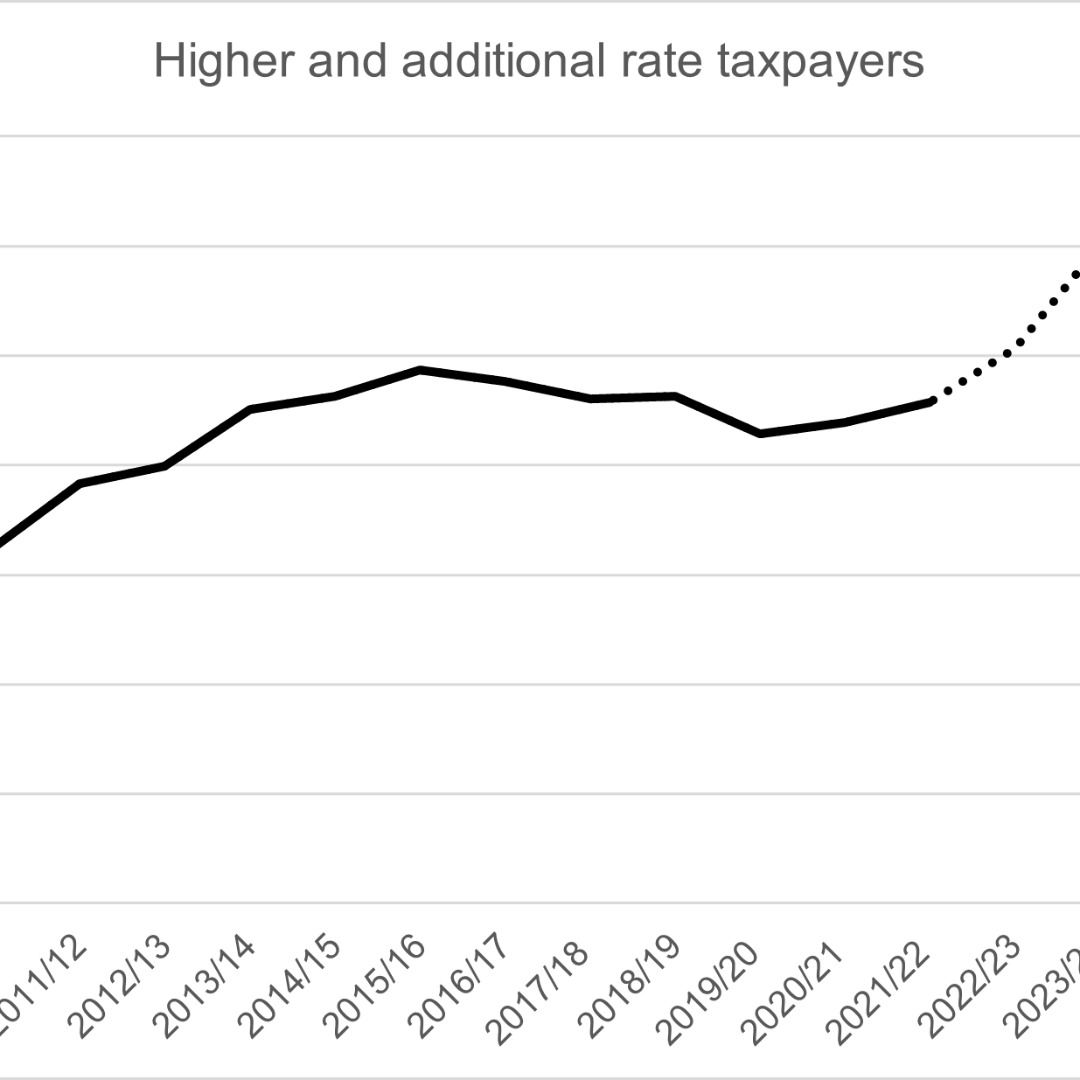
Sharp rise in higher rate taxpayer numbers…….

……and if that’s you, then advice is now more important than ever.

There was once a time when paying tax at more than the basic rate made you a member of a somewhat select club. In 2010/11, the first year in which additional rate tax was introduced, the proportion of taxpayers who were taxed at more than the basic rate was 10.4%.

Five years later, a dose of austerity pushed the figure close to 16%. Then it began to drop as higher rate thresholds were raised, so that by 2019/20 it was down to 13.6%. From that low, the upward path was resumed.

Alongside the Chancellor’s Spring Statement in March, the Office for Budget Responsibility (OBR) issued estimates that the freeze in the personal allowance and, outside Scotland, and basic rate bands through to 2025/26 will mean by that year almost 19% of taxpayers will be liable for higher rate tax.

The number of taxpayers will also be increasing too because of the personal allowance staying at £12,570. The rising taxpayer numbers explain why the Chancellor could announce a 1p cut in basic rate tax in 2024/25 at the same time as the OBR calculated that income tax revenue for the year would increase by £12 billion. Scotland already has a starter rate of 19%.

If your head is spinning from all the numbers, there is a simple message you: you are likely to pass more of your income to HMRC in the coming years. To limit just how much extra the Exchequer gains and you lose, there are plenty of actions to consider wherever you are in the UK:

  • If you are married or in a civil partnership, make sure you are maximising the benefits of independent tax and, if you are eligible, claiming the transferable marriage allowance.
  • Check your PAYE code – it could be wrong.
  • Ensure you are claiming full tax relief on the pension contributions you make. Do not assume this will be given automatically, especially if you pay higher rate tax.
  • Consider an ISA first for any investment as it is free from UK income tax and capital gains tax.
  • Choose any employee perks with care. Some are highly tax efficient, while others carry a heavy tax burden.

Remember that if you are or likely to become a member of the ever-expanding higher rate taxpayer club, the value of taking independent financial advice rises with your tax rate.

Source: ONS data, OBR projections.

A new breed of digital nomad

The pandemic has freed many workers from the confines of the office, leading to the emergence of a new breed of digital nomad – people who can take their laptop, jump on a plane and set up a remote ‘office’ somewhere exotic.

Some countries have responded with schemes to assist long-term workcations. For example, with the Barbados Welcome Stamp, digital nomads can stay in Barbados for up to 12 months with no tax implications – the fee is $2,000 for an individual. But before packing your bags there are some practicalities that cannot be overlooked.

The self-employed should not have any insurmountable problems, but employees will need to consult with their employer to see if they are going to be supportive of a move away, potentially to a different time zone.

UK property

There might not be much of a problem if currently renting in the UK, but home ownership comes with more issues. Simply leaving a home empty – even if affordable – could be in breach of the mortgage agreement and may invalidate household insurance. Property rental is a solution but means meeting serious requirements; a good letting agency should be able to advise. Some remedial work may be necessary, such as the installation of fire alarms.

You should definitely retain your UK bank account, but also look at online options for holding currency and transferring funds overseas.

Tax status

It’s all very well having tax-exempt status where you are based, but it is of limited benefit if you remain subject to UK tax. It is important to remember that UK residence status is determined separately for each tax year. The rules can be quite complicated, but you can be classed as non-resident if you:

  • Spend fewer than 16 days in the UK during a tax year. Unfortunately, it’s probably too late now to meet this requirement for the current year;
  • Work full-time overseas, whether self-employed or employed – and you are allowed to visit the UK for up to 90 days each tax year; or
  • Balance your visits and ties to the UK. For example, if you just make use of a UK home, UK visits will need to be restricted to no more than 90 days.

A good starting point for establishing residence status is HMRC’s guidance on the statutory residence test. This can be found here.

Photo by Peggy Anke on Unsplash

NICs boost for the self-employed

Prior to the March Spring Statement, most self-employed individuals were facing increased national insurance contribution (NIC) bills this year. However, those with profits up to and just over £28,000 will now see a fall in the amount they pay compared to last year. What’s more, low earners can benefit from deemed contributions.

Class 4 NICs

The introduction of the 1.25% health and social care levy from 6 April put up the rates of profit-related class 4 NICs to 10.25% and 3.25%. However, the rate increase has been mitigated by a substantial uplift to the starting threshold. It was going to be set at £9,880 but will now be £11,908 across the 2022/23 tax year. For 2023/24, the threshold will be fully aligned with the income tax personal allowance of £12,570.

Although the freezing of the upper threshold at £50,270 is pushing more people into higher rate income tax, it is actually beneficial for NIC purposes. Extra profits are subject to NICs at 3.25% instead of 10.25%.

Class 2 NICs

The threshold at which fixed-rate class 2 NICs become payable was due to increase from £6,515 to £6,725. However, this threshold has also now been set at £11,908, and will be aligned with the personal allowance for 2023/24.

The £6,725 threshold has not, however, been discarded. In a big change for class 2 NICs, self-employed people with profits between £6,725 and £11,908 for 2022/23 are deemed to have made contributions without actually having to pay them. They will therefore continue to build up their contribution record. This is particularly important for State pension purposes where 35 qualifying years are required to obtain the maximum.

The deemed contribution threshold might mean a useful tax planning opportunity. For example, if profits for 2022/23 are set to be £12,000, spending £200 on, say, a new telephone before the year end will avoid the cost of class 2 NICs, and also save some income tax and class 4 NICs.

Overall impact

The table shows the overall impact of the Spring Statement changes at different profit levels:

Profit 2021/22 2022/23 (Original) 2022/23 (Now)
£10,000 £197 £176 Nil
£15,000 £647 £689 £481
£20,000 £1,097 £1,201 £923
£30,000 £1,997 £2,226 £2,018

The Spring Statement factsheet explaining the changes can be found here.

What is a ‘reasonable excuse’ for tax penalties?

Having a reasonable excuse can be a get-out-of-jail-free card if you are charged a tax penalty. However, there is no statutory definition of the term, and what might constitute a reasonable excuse for one person may not for another. With more individuals and businesses incurring tax penalties due to Covid-related disruptions, HMRC has recently updated its guidance.

The use of a reasonable excuse only removes the penalty – it does not absolve the taxpayer from the tax or any late-payment interest.

Covid-related disruptions

HMRC will usually accept the use of a reasonable excuse for a return or late payment because of the impact of Covid-19. As is always the case with reasonable excuse, the excuse must have existed on or before the date on which the obligation should have been met.

It is also essential that the failure to meet the conditions is rectified without unreasonable delay once the reasonable excuse ends.

For example, if a business is late submitting its quarterly VAT return because the person responsible had to isolate – this should be accepted as reasonable excuse provided the return is submitted as soon as possible after the person returns to work.

What doesn’t count

HMRC’s updated guidance provides some examples of what will not usually amount to a reasonable excuse:

  • Pressure of work;
  • Lack of information; and
  • Lack of a reminder from HMRC.

Lack of funds and reliance on a third party also do not normally count, although there are exceptions. For example, the First-Tier Tribunal held that a taxpayer had a reasonable excuse for the late payment of a capital gains tax liability because the sale proceeds had not been received.

Illness

Illness and domestic problems do not count as valid excuses unless very serious. HMRC expects suitable arrangements to be put in place if a person knows in advance that they will be in hospital or convalescing.

Similarly, the illness of a partner or a close relative will only be accepted as an excuse if the situation took up a great deal of time and resources.

HMRC guidance on what to do if you disagree with a tax decision – including reasonable excuse – can be found here.

Photo by Towfiqu barbhuiya on Unsplash

Keeping it in the family – tax saving salary strategies

An easy way to reduce a business’s tax bill – and also increase the amount of funds withdrawn from the business – is to put a family member on the payroll. Of course, the salary must be for genuine work (emphasis on this point!!), with any tax saving dependent on the overall tax position.

Such salary arrangements are most beneficial if they are in place from the start of a tax year, so right now is a good time to be looking at 2022/23.

When does this work?

Paying a salary to a spouse, partner or child at university makes sense if the recipient is not using their personal allowance. A tax-free salary can be paid, with the business or company receiving a corresponding deduction in calculating their trading profit. For a sole trader, the saving could be as high as 63.25% if caught in the personal allowance tax trap.

However, there will also be a saving if the recipient is using their personal allowance but has a lower marginal tax rate than their self-employed spouse, partner or parent. With a company, there is currently no advantage to taking a salary in this situation, but there will be from April 2023 when higher corporate tax rates come into effect.

One important point to remember is that the salary must actually be paid out for the work, so it should be payrolled and transferred into the family member’s personal bank account.

How much to pay?

There are two main restrictions:

  • The amount of salary must be commensurate with the work done; HMRC will refuse a tax deduction if no work or little work is undertaken. Work will obviously depend on the recipient’s skill set, but bookkeeping, payroll, marketing, or website maintenance might be options; and


  • Keeping the national insurance contribution (NIC) cost to a minimum. With employee and employer NICs set to be 13.25% and 15.05% respectively from April, these can easily wipe out any tax saving. An annual salary for 2022/23 of between £6,396 and £9,880 will mean no employee NICs and will also give the recipient a year’s contribution towards the State pension. Paying up to the annual personal allowance of £12,570 can work if employer NICs are covered by the employment allowance.

HMRC’s approach to allowing a deduction for salary paid to dependents and close relatives can be found here.

A caveat to anyone interested in this article’s content: do make sure you seek professional advice before embarking on this strategy, as getting it wrong could have severe consequences for you and/or your business.

Photo by Daniel K Cheung on Unsplash