Self-assessment threshold rises from 2023/24

There is a long list of reasons why it is necessary to complete a self-assessment tax return, but PAYE taxpayers are generally exempt from the requirement. Previously, exemption was subject to a £100,000 income ceiling, but the threshold has been increased to £150,000 for the current tax year onwards.

The £150,000 threshold applies to total income – not just gross salary – and also any taxable benefits and income from savings and investments.

Other reasons to file a return

There are a number of other reasons why an employee with income below £150,000 will still be required to complete a tax return. For example, where the taxpayer also has:

  • Income from property rental;
  • More than £10,000 in either dividend income or savings income;
  • Income from a trust;
  • To pay capital gains tax (more likely now with the exempt amount reduced from £12,300 to £6,000);
  • Income from self-employment or partnership income; or
  • To pay the High Income Child Benefit Charge.

When a return is not required

Employed taxpayers with income between £100,000 and £150,000 for 2022/23 ­– and with no other reason for completing a return – should receive a self-assessment exit letter from HMRC confirming that they do not need to complete a return for 2023/24.

In other situations, it will be necessary for taxpayers to contact HMRC and inform them why a return is no longer necessary.

Taxpayers can ask for a return to be withdrawn even after HMRC has charged late filing penalties. Subject to HMRC agreement, the penalties will then be waived.

Even if a tax return is not strictly required, there are some situations where a taxpayer might want to complete a return anyway. The main reason will normally be to claim a relief, such as pension contributions or donations to charity.

If a tax return is not submitted, it will be more important than ever to check your tax code, which will typically be used to collect tax on taxable benefits and savings income.

To check if a self-assessment tax return is required, use HMRC’s online tool found here.

Photo by Leon Dewiwje on Unsplash

Profit withdrawal changes for 2023/24

Owner-managers have historically benefited by withdrawing profits by way of dividends, rather than taking director’s remuneration, due to the national insurance contribution (NIC) saving. However, tax changes taking effect from April 2023 will mean this approach may no longer be such an attractive option.

From 1 April 2023, the current 19% rate of corporation tax will only be available for the first £50,000 of profits. On profits between £50,000 and £250,000, the effective rate will be 26.5%, with 25% payable thereafter. As far as personal tax is concerned for 2023/24:

  • The tax-free dividend allowance will be cut from £2,000 to £1,000; and
  • Dividend tax rates are not reduced by 1.25% in line with the reduction to NIC rates.


Case study

The profit withdrawal decision will differ from owner-manager to owner-manager, but let’s take the situation where company profits are forecast to be £150,000 for the year ended 31 March 2024 and the owner-manager wants to withdraw £50,000 either as dividends or director’s remuneration (this will be their only income). The company does not have any other employees.

  • Dividend: After allowing for corporation tax, a dividend of £36,750 can be taken. Income tax on this will be £2,028, so net of tax income is £34,722.
  • Remuneration: After allowing for employer NICs, gross remuneration of £45,040 will be paid. After income tax and employee NICs, the net of tax income is £34,650.

There is virtually no difference between the two options. However, the remuneration option would be better if some or all of the £5,000 employment allowance was available to set against employer NICs. At higher levels of income, dividends have the advantage – for example, some £1,793 more in net of tax income for a £100,000 withdrawal – but again, the availability of the employment allowance could swing this around.

The employment allowance is not available if a director is the sole employee. This can be rectified by employing a family member and paying them at least £9,100 a year. The salary must of course be justified.

Forecast

Directors who want to take regular monthly or quarterly dividend payments will need a fairly accurate forecast of company profits. This might be difficult, but directors – assuming they have sufficient funds to live on – have the option of waiting until towards the end of the tax year before deciding on a profit withdrawal strategy, as the tax position will not change.

Higher Scottish rates of income tax mean the remuneration option is more expensive for Scottish taxpayers. It is assumed that rates of NIC will remain unchanged for 2023/24.

Tax rates and allowances for 2023/24, along with some useful tax calculators, can be found here. Scottish income tax information can be found here.

Photo by LinkedIn Sales Solutions on Unsplash

Tackling rising employment costs

The 9.7% uplift to the National Living Wage from April 2023 should be welcome news for lower-paid workers, but could present problems if their employer simply cannot afford the increased cost of employing them.

The cost of living crisis is impacting many businesses, especially those in the hospitality sector. Some will cope with rising employment costs by reducing their headcount, but others may have no choice but to close up shop. Small businesses owned by self-employed people are likely to be hit particularly hard.

On top of this, the freezing of the employer national insurance contribution (NIC) threshold until April 2028 will also mean an increased NIC cost for many businesses.

Wage increase

The National Living Wage is paid to employees aged 23 and over, with similar percentage increases to the rates payable to younger employees. The percentage increase for 21- to 22-year-olds at 10.9% is even higher.

  • For each full-time worker aged 23 and over, the increase will see employers having to pay nearly £2,000 more a year in gross salary, with pension, holiday pay and NIC costs on top.
  • There will probably be a knock-on effect higher up the pay scale, with other employees looking for an equivalent salary boost.

Some employers might be tempted to try and cut their wage bill by turning to ‘self-employed’ workers. However, employment status is not simply a matter of choice, and incorrect categorisation can have serious implications.

NIC threshold

The employer threshold is to be frozen at its current level of £9,100, although the annual employment allowance of £5,000 will shield smaller employers (with just two or three employees) from the impact of this decision.

Larger employers will see a stealthy increase to their NIC cost as wages increase, but the starting threshold for NIC remains unchanged.

The minimum wage rates from April 2023 can be found here.

Photo by Alex Kotliarskyi on Unsplash

Dividends vs remuneration: the corporation tax quandary

For owner-managed companies, bonuses, dividends and remuneration will become yet more complex in the new tax year.

With the corporation tax increase and dividend rates now confirmed by the Government, the dividend vs remuneration decision for owner-managed companies is likely to become more complicated in 2023/24, particularly when it comes to bonuses.

Historically, it was preferable to extract company profits through dividends rather than through director’s remuneration. This is because of the national insurance contribution (NIC) cost attached to remuneration.

However, from 1 April 2023, there will be a substantial increase to the rate of corporation tax once profits hit £50,000. On profits between £50,000 and £250,000 the rate will be 26.5%, with the 19% rate only available for the first £50,000 of profits.

The bonus decision

The tax position will differ in each case, but let’s take a situation where a higher rate taxpayer wants to take a bonus of £40,000 from their company, which is in the 26.5% corporation tax bracket. The director has already used their tax free dividend allowance.

Dividend
After allowing for corporation tax, a dividend of £29,400 can be taken. Income tax on this will be £9,923, so the net income is £19,477.

Remuneration
After allowing for employer NICs (assuming the rate does not increase next year), the gross remuneration would be £35,149. After income tax and employee NICs are applied, the net income is £20,386.

In this case, remuneration is the beneficial option (and would be better still if some or all of the employment allowance was available). Without the corporation tax increase, the situation would have been reversed.

Of course, the situation could change if the Government decides to reinstate the additional 1.25% percentage points to NIC rates (albeit, in this particular example, the remuneration option would still be marginally better).

Other factors to consider

There are several other advantages to paying remuneration rather than dividends to consider too:

  • Dividends must be paid to all shareholders.
  • A dividend has to be covered by a company’s profits.
  • Dividends do not always count as income when applying for a mortgage.

As these examples illustrate, the corporation tax landscape has become more complicated. Although a Government guide clarifies things somewhat, it’s always best to seek professional advice rather than risk losing valuable income.

Photo by Austin Distel on Unsplash

Over-65s set new employment record

The latest data from the Office for National Statistics (ONS) reveals that more people than ever are working beyond age 65.

One of the stranger economic statistics of recent times has been the strength of employment markets on both sides of the Atlantic. For all the talk of an impending recession and the upward march of interest rates, employment has remained buoyant in both the UK and the US. The unemployment rate in both countries is under 4.0%, which is about as close to full employment as can be reached. The latest estimate for the UK is that unemployment numbers are 42,000 less than job vacancies, whereas in the US, job openings are double the unemployed numbers.

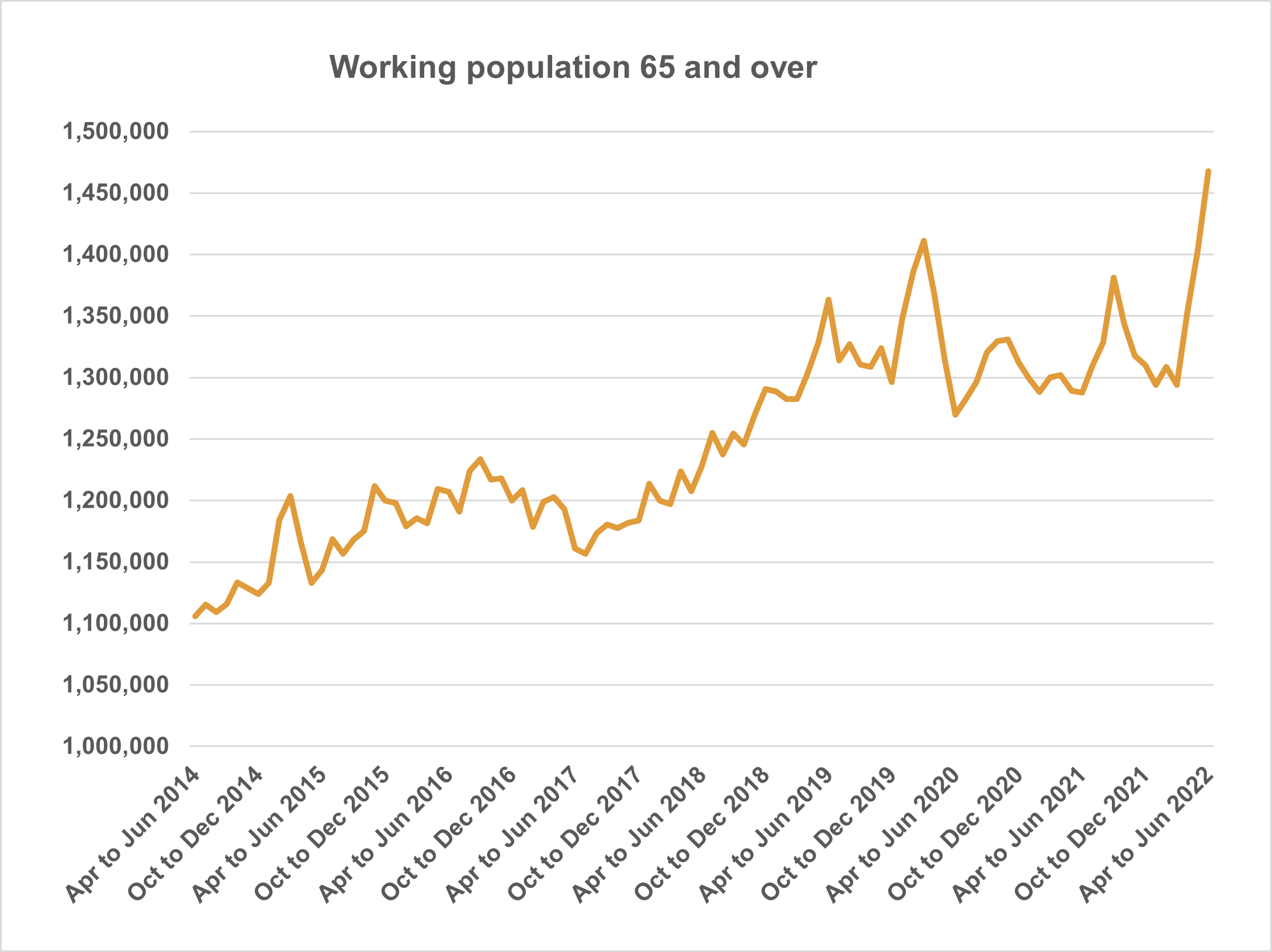
A notable feature of the UK employment market has been the increase in the population aged 65 and over who are in work. The latest data from the ONS – covering the period April to June 2022 – showed both a record quarterly increase and a record total of close to 1.5 million, of whom nearly three quarters were employed. Viewed another way, 15.5% of men and 9.2% of women aged 65 and over were in work during this period.

The longer-term ONS figures show that over the last ten years, while overall employment has risen by about a tenth, employment among those aged 65 and over is up by a little over a half. These senior workers are not labouring all week, but they are, on average, putting in nearly 22 hours. The recent joiners of the 65-and-over workforce are predominantly part-timers, both employed and self-employed, according to the ONS.

What the ONS statistics do not reveal is why employment is growing so rapidly in this sector of the population. There is a clue in the fact that, to quote the ONS, “The industries where informal employment is more common, such as hospitality and arts, entertainment and recreation, saw some of the largest increases.”

The combination of sharply rising inflation and the increase in state pension age to 66 is likely to be forcing some former retirees back into work to make ends meet. It does not help that the April 2022 increase in the state pension was 3.1%, less than a third the current (August) rate of CPI inflation.

If the idea of joining that growing band of those still working at 65 and over does not appeal, then make sure your retirement planning provides you with enough income when you need it.

Source: ONS 9/2022.

The rise of mini umbrella company fraud

The rise of mini umbrella company fraud continues to concern HRMC which has recently updated its guidance for businesses that either place or use temporary labour. Mini umbrella companies can be used to abuse the VAT flat rate scheme and the national insurance contribution (NIC) employment allowance.

The VAT flat rate scheme can only be used if a business’s turnover is no more than £150,000, and the NIC employment allowance covers the first £5,000 of employer NIC liability each tax year.

Fraud

Mini umbrella company fraud is where multiple limited companies are created, with only a small number of temporary workers employed by each one.

Businesses should be aware of the potential dangers in their labour supply chain – apart from the impact on reputation, the business’s workers may end up receiving less than they are entitled to.

Workers are often unaware of the arrangements, may not even know who their employer is, and might be regularly moved around between different mini umbrella companies. The use of the mini umbrella company model can mean the loss of some employment rights.

Warning signs

Mini umbrella companies will normally be low down in the supply chain, so it can be challenging to spot them. Warning signs include:

  • Unusual company names: The companies are often set up around the same time and given a similar or unusual name.
  • Unrelated business activity: The business activity listed at Companies House may not relate to the services provided by the worker.
  • Foreign national directors: Foreign nationals – who have no previous experience in the UK labour supply industry – are often listed as directors.
  • Movement of workers: Employees are moved frequently between different mini umbrella companies.
  • Short-lived businesses: Mini umbrella companies typically have a relatively short lifespan – often less than 18 months – before being dissolved by Companies House for not meeting filing obligations.

HMRC’s updated guidance on mini umbrella company fraud can be found here.

Photo by J W on Unsplash

Getting in touch: HMRC’s new email facility

Although there is no general facility to contact HMRC by email, it is slowly moving into the 21st century by providing the option to receive an email response. But of course, this comes with a few conditions.

Dealing with HMRC by post can be a slow process. With resources having been spread more thinly than ever due to the Covid-19 pandemic and Brexit, HMRC has only recently been working its way through the built-up backlog of post.

Scam risks

Scammers can use fake HMRC emails as a way of obtaining personal information, although, with improved scam email detection, they have now largely switched to text messaging. Nevertheless, HMRC points out the risks associated with using email. Their guidance raises various concerns:

  • Emails sent may be intercepted and altered.
  • Attachments could contain a virus or malicious code.

To reduce the risk, HMRC will desensitise information, by, for example, only quoting part of a unique reference number.

Confirmation

Anyone who would like to be contacted by email has to confirm to HMRC in writing by post or email that:

  • They understand and accept the risks of using email;
  • They consent to financial information being sent by email;
  • Attachments can be used; and
  • Junk mail filters are not set to reject and/or automatically delete HMRC emails.

HMRC should also be sent the names and email addresses of all people to be contacted by email, such as business owners, staff and the business’s tax agent.

Confirmation will be held on file by HMRC and will apply to future email correspondence, with the agreement reviewed at regular intervals to make sure there are no changes. The use of email can be cancelled at any time by simply letting HMRC know.

HMRC publish a list of recent emails it has sent out to help people determine if an email is genuine. This list can be found here.

Photo by Brett Jordan on Unsplash

Planes, trains and automobiles – managing employees’ transport challenges

With strikes and cancellations affecting trains, the underground and flights, employers need to decide how they are going to treat employees who cannot get into work or are stuck overseas.

Commuting

Although inconvenient, there is generally plenty of notice when it comes to train, tube and tram strikes, and therefore the chance to make contingency plans. With hybrid and homeworking now commonplace for many offices, this will be the simple and obvious answer to discuss with employees on affected days.

Employees who are required to attend work in person may face a longer and/or more expensive journeys than normal – especially if an alternative mode of transport is required. So employers should consider offering help with some financial assistance. Some absences may be avoided by rearranging work patterns or promoting car-pooling for instance.

Stuck overseas

The treatment of employees who cannot return to work after a holiday because they are stuck overseas due to a cancelled flight is somewhat more problematic.

  • If an employee can resume work as usual while abroad then they should obviously be paid as normal. It is unrealistic, however, to expect most employees – especially if not in a senior position – to have travelled with their work laptops.
  • Assuming sufficient annual leave is available, extending a holiday may be an answer where an employee is unable to work remotely. Or the employee may be happy to take unpaid leave.
  • Although there is no requirement to otherwise pay an employee who is stranded overseas, the employer might consider treating it the same as an emergency situation and remunerating on a similar basis to other emergencies, especially if the employee is taking all reasonable steps to return home.

Employees may not be able to leave the UK for their holiday in the first place and so need to rearrange their dates. Employers do not have to agree to this, especially given short notice, but a flexible approach is advisable where possible.

The Government’s guide to holiday entitlement for employers and employees can be found here.

Photo by Lisanto 李奕良 on Unsplash

Keeping it in the family – tax saving salary strategies

An easy way to reduce a business’s tax bill – and also increase the amount of funds withdrawn from the business – is to put a family member on the payroll. Of course, the salary must be for genuine work (emphasis on this point!!), with any tax saving dependent on the overall tax position.

Such salary arrangements are most beneficial if they are in place from the start of a tax year, so right now is a good time to be looking at 2022/23.

When does this work?

Paying a salary to a spouse, partner or child at university makes sense if the recipient is not using their personal allowance. A tax-free salary can be paid, with the business or company receiving a corresponding deduction in calculating their trading profit. For a sole trader, the saving could be as high as 63.25% if caught in the personal allowance tax trap.

However, there will also be a saving if the recipient is using their personal allowance but has a lower marginal tax rate than their self-employed spouse, partner or parent. With a company, there is currently no advantage to taking a salary in this situation, but there will be from April 2023 when higher corporate tax rates come into effect.

One important point to remember is that the salary must actually be paid out for the work, so it should be payrolled and transferred into the family member’s personal bank account.

How much to pay?

There are two main restrictions:

  • The amount of salary must be commensurate with the work done; HMRC will refuse a tax deduction if no work or little work is undertaken. Work will obviously depend on the recipient’s skill set, but bookkeeping, payroll, marketing, or website maintenance might be options; and


  • Keeping the national insurance contribution (NIC) cost to a minimum. With employee and employer NICs set to be 13.25% and 15.05% respectively from April, these can easily wipe out any tax saving. An annual salary for 2022/23 of between £6,396 and £9,880 will mean no employee NICs and will also give the recipient a year’s contribution towards the State pension. Paying up to the annual personal allowance of £12,570 can work if employer NICs are covered by the employment allowance.

HMRC’s approach to allowing a deduction for salary paid to dependents and close relatives can be found here.

A caveat to anyone interested in this article’s content: do make sure you seek professional advice before embarking on this strategy, as getting it wrong could have severe consequences for you and/or your business.

Photo by Daniel K Cheung on Unsplash

Sick pay rebate returns to help relieve pressure on businesses

The Statutory Sick Pay Rebate Scheme (SSPRS), which ended on 30 September 2021, was reintroduced from 21 December 2021, with employers able to make retrospective claims from mid-January. The scheme’s return is in response to heightened levels of staff sickness due to the Covid-19 Omicron variant.

Statutory sick pay is not normally recoverable, but the SSPRS means that small and medium-sized businesses can reclaim SSP paid to employees affected by Covid-19.

What is covered?

The SSPRS only covers Covid-related absences (someone who has symptoms, is self-isolating or is shielding) for up to two weeks of SSP for each employee. The rate of SSP is currently £96.35 a week.

The two-week limit has, however, been reset, so an employer can make a fresh claim of up to two weeks regardless of whether a claim was made under the previous scheme. More than one claim can be made for an employee, subject to the two-week maximum.

There are no details indicating when the SSPRS will end, although the government will keep the scheme under review.

Qualifying employers

The most important condition is that the SSPRS is only available to employers with fewer than 250 employees. This test must be met on 30 November 2021. The employer must also:

  • Be UK based;
  • Have a PAYE payroll system that started on or before 30 November 2021; and
  • Have already paid the employee’s Covid-related sick pay.

To make a claim, an employer will need the Government Gateway login used when they registered for PAYE Online.

Record-keeping

Employers must retain records of any SSP they have claimed back under the SSPRS for three years from the date repayment is received.

The records should include the reason an employee said they were off work due to Covid-19.  Employees are now able to temporarily self-certify absences for 28 days, rather than the usual first seven days only.

Further guidance and the starting point for making a claim under the SSPRS can be found here.

Photo by David Mao on Unsplash