Updated tax guidance for electric company car charging

HMRC has updated its guidance to clarify that there is no taxable benefit when an employer reimburses employees who charge their electric company cars at home. Previously, HMRC maintained that the relevant exemption did not apply.

There is a general rule that no income tax liability arises where an employee is reimbursed for expenses incurred in connection with a company car – such as repairs, insurance and car tax. Although this exemption does not apply to car fuel, electricity is not treated as fuel for tax purposes.

Exemption

The exemption applies whether a company car is used solely for business mileage, solely for private mileage or where there is mixed use.

  • Although HMRC’s guidance has been updated, at the time of writing their tool to check if you need to pay tax for charging an employee’s electric car is still giving incorrect answers, unless a company car is used solely for business mileage.
  • National insurance contribution (NIC) guidance is in line with the income tax guidance, so there are no class 1 or class 1A NICs on reimbursements for charging an electric company car at home.

Employers do, however, need to ensure that the cost of electricity reimbursed is solely for the company car.

Employers, directors and employees who have previously followed HMRC’s incorrect guidance should be entitled to a refund of the tax and NICs that have been overpaid.

Other charging situations

There is no taxable benefit if an electric company car is charged at work, if a charge card is provided so that public charging points can be used, or if the employer pays for a charging point to be installed at an employee’s home.

If the employer does not reimburse for charging an electric company car at home, the employee can claim a deduction from earnings for the electricity cost of business mileage.

The relevant section of HMRC’s employment income manual can be found here.

Photo by CHUTTERSNAP on Unsplash

Handy hints ahead of self-assessment

The 31 January 2024 deadline for submitting a 2022/23 self-assessment tax return is not far off, especially for those not yet registered.

Anyone who has not previously registered for self-assessment – but needs to submit a tax return for 2022-23 – should do so as soon as possible.

  • A self-assessment activation code can take a week to arrive (three weeks if overseas); and
  • It can take two weeks (again, three weeks if overseas) to obtain a unique taxpayer reference, although using a personal tax account or the HMRC app can speed things up.

For anyone who has not previously submitted a tax return, the deadline for informing HMRC of the need to do so for 2022/23 has already passed. Individuals who have missed the deadline might face a fine.

First-time registration

There are a number of reasons why a taxpayer might fall into the self-assessment system for the first time. For example, anyone who has:

  • Started part-time self-employment, including work in the gig economy, trading on eBay and similar websites, or earning money as an influencer (although the first £1,000 of self-employed income is exempt);
  • Disposed of cryptoassets (any profits are subject to capital gains tax); or
  • Rented out property for the first time, possibly through sites such as Airbnb (again, the first £1,000 of rental income is exempt).
  • Become liable to the High Income Child Benefit Charge as a result of their income exceeding £50,000.

Sooner rather than later

Leaving registration to the last moment will mean there is no time to deal with any unforeseen problems. You might need to consult HMRC’s self-assessment helpline, which is now available again after its summer closure.

There will also be little time before the related tax bill is due for payment, and this could be an issue if the amount payable is higher than expected.

More information about whether you need to submit a self-assessment tax return can be found here.

Photo by Markus Winkler on Unsplash

Company cars: not-so-free fuel

If your employer pays for the fuel in your company car, it may cost you more than you expected.

As the Autumn Statement was not a Budget, detailed publications that would normally emerge as the Chancellor sat down have taken time to appear. For example, the HMRC projections of how many more capital gains tax (CGT) payers there would be because of the much-reduced annual exemption (another 570,000 by 2024/25) did not appear until the Monday after the Autumn Statement, missing the weekend personal finance pages.

One even later arrival – three weeks after the Autumn Statement – was an HMRC bulletin on the fuel benefit charge for company cars in 2023/24. For some years the basis has been an increase in line with September annual CPI inflation (published in mid-October), so there was no explicit reason for HMRC’s procrastination. The number that was eventually revealed was the current figure, increased by 10.1%, as had been expected.

Taxable value for 2023/24

That means for 2023/24 if you have ‘free’ fuel, its taxable value will be assessed by multiplying £27,800 by your car’s percentage scale charge. For example, if you have a petrol-engine car with CO2 emissions of 130–134 g/km, your scale charge is 31% and £8,618 (£27,800 x 31%) will be added to your income for tax purposes. In terms of hard cash, that is an extra £3,447 going to the Exchequer if you are a 40% taxpayer.

At this point you are probably wondering how far £3,447 of petrol would take you. Assume a price of £1.60 a litre and 40 miles a gallon and the answer is about 19,000 miles. In 2019, before the pandemic disrupted travel, the average car covered 7,400 miles a year. If that figure still applies – and it is probably less because of increased working from home – then the ‘free’ fuel break-even point is more than 250% of typical use.

Not all benefits are so harshly taxed – electric cars can be an attractive option – but the large cost of ‘free’ fuel is a reminder that when it comes to anything financial, ‘free’ is a word to be treated with great caution.

Photo by Hans Isaacson on Unsplash


Friday Afternoon Meanderings; What Is The Future of The Company Car Benefit?

It’s not often I get nostalgic, but every once in a while, I harken back to my days in the Revenue (now “HMRC”) and in practice as a tax consultant;  to a time when the company car was the fringe benefit that every employee wanted. As my somewhat fuzzy memory recalls, you had ‘made it’ once you had the keys to a car with no worries about servicing, insuring or, sometimes, even fuel costs. It could also make plenty of tax sense, as the cost of the car was not fully reflected in the amount on which tax was charged. Go back far enough and two company cars were not uncommon for some senior executives.

Unsurprisingly, the days of company cars as tax-efficient remuneration have largely passed, other than for electric vehicles. The government approach to company cars brings to mind the comment of Jean-Batiste Colbert, a 17th century French Minister of Finance, who said “the art of taxation consists in so plucking the goose as to procure the largest quantity of feathers with the least possible amount of hissing”.

Some 400 years later, successive UK chancellors have steadily notched up the company car benefit scales to raise additional revenue from a stable to shrinking number of company car drivers. For example, the latest HMRC data show that between 2010/11 and 2018/19, the average company car taxable value has risen by 57% against a 19% increase in inflation over the same period.

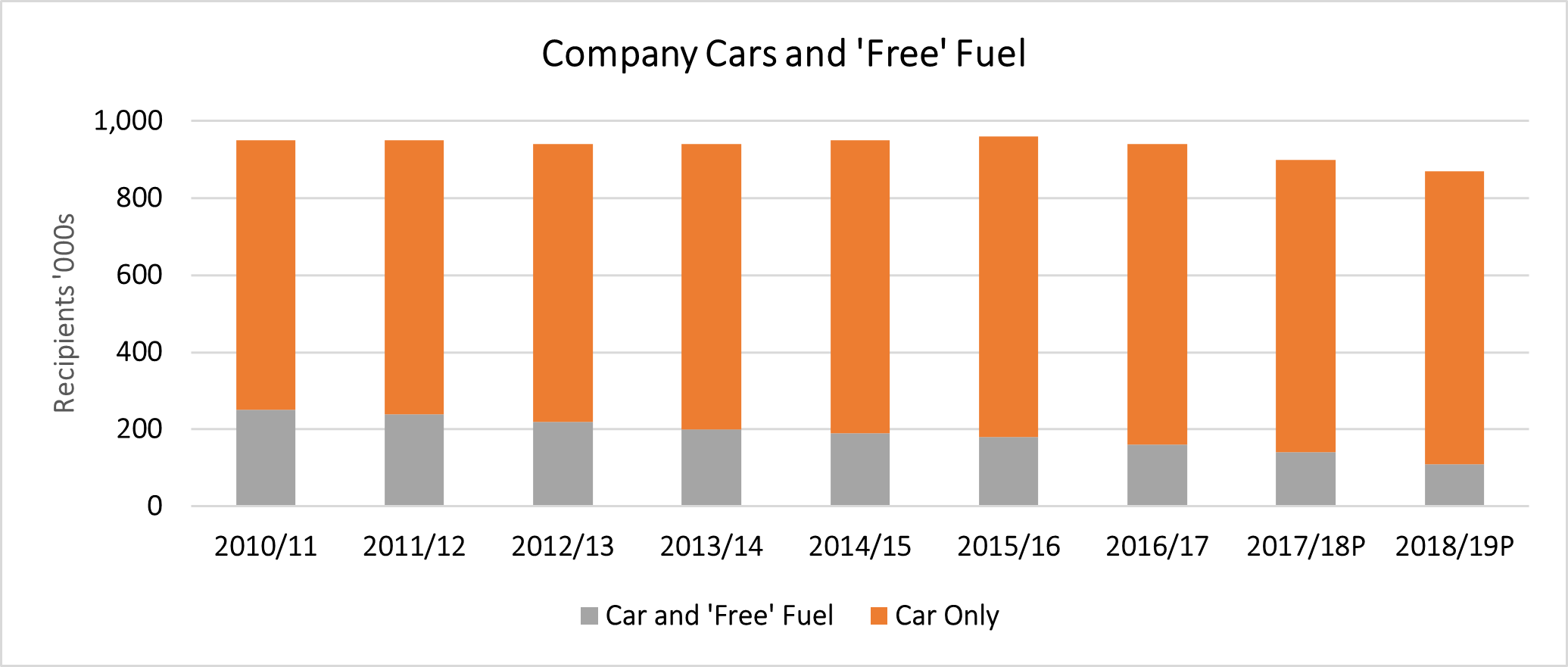
Similarly, the taxable value of ‘free’ fuel (i.e. employer-funded fuel) has risen by 44%. As the graph shows, the popularity of ‘free’ fuel has steadily fallen – only about one in eight company car drivers now pays nothing to fill up their tank. If you are one of that minority, do make sure you have enough private mileage to justify the tax you pay. The main reason for the drop in ‘free’ fuel numbers is that for many employees, the tax bill would be greater than their personal refuelling cost.

The gradual demise of the company car is a lesson in how the tax system can subtly alter over time. A major revamp in the treatment of salary sacrifice schemes introduced in 2017 changed the tax landscape for other fringe benefits, too. The one that has survived and still remains attractive – at least for now – is salary sacrifice to fund pension contributions.

Source: HMRC September 2020


When is a van a car?

The tax treatment of cars and vans is quite different, with van classification far more beneficial from both an employer and employee perspective. However, the distinction is not always clear-cut, especially where vans have been modified to turn them into multi-purpose vehicles.

In what is now being referred to as the “Coca Cola van case”, the Court of Appeal has ruled that three modified crew-cab vehicles provided by Coca-Cola to its employees, who used them privately, are cars rather than vans, despite the vehicles having the outward appearance of a van.

Modification

The three vans in question were panel vans modified with a second row of seats behind the driver, turning them into crew cabs. With two of the vehicles, the additional seats could only be removed with tools. For the other vehicle, the seats were removed during working hours.

Primarily suited

For benefit purposes, classification as a van depends on a vehicle being primarily suited to the carrying of goods.

The Court of Appeal’s view was that the modifications had transformed the three vans into multi-purpose vehicles, equally suitable for carrying either goods or passengers. Not being primarily suited to the carrying of goods, the vehicles therefore did not qualify as vans.

What a vehicle looks like on the inside overrides its outward appearance.

The decision could also see crew cabs reclassified for capital allowance purposes (so no annual investment allowance), but still considered vans for VAT purposes provided they can carry a payload of one tonne or more.

Implications

Employers should be aware of the tax implications of providing similar modified crew cab vehicles where private use is permitted.

The decision will mean a higher benefit charge for employees, and additional class 1A NICs for employers. The change should be applied from 2020/21 onwards, and also potentially backdated to 2018/19 (when the case was heard at the Upper Tribunal).

HMRC guidance on the difference between cars and vans for car benefit purposes can be found here .

Photo by Paul Hanaoka on Unsplash


Taxation of electric vehicles (from 6 April 2021)

With the government announcing there will be no van benefit charge for fully electric company vans from 6 April 2021, you might be forgiven for thinking that having a company electric vehicle avoids any tax cost. However, this is not quite always the case.

You can currently be subject to a van benefit charge if you have the use of a company van which is also used privately. Unlike company cars, the definition of ‘private use’ for a company van does not include your normal commute to work.

Over recent tax years, the fully electric van benefit charge has been set at an increasing percentage of the full charge, and for 2020/21 it is 80% (£2,808) of the full amount. The exemption to be introduced from 6 April 2021 will apply in all circumstances.

Company cars

Although fully electric company cars escape any car benefit charge for the current tax year, the percentage charge will be set at 1% next year, increasing to 2% for 2022/23. This will still make fully electric company cars very tax effective.

For a higher rate taxpayer, the monthly tax cost of a Tesla Model S, for example, with a list price of £96,000 will be just £32 in 2021/22 and £64 a year later.

Fuel benefit

For benefit purposes, electricity is not treated as a fuel. This means there can be no fuel benefit for a fully electric vehicle, even if the employer installs a vehicle charging point at the employee’s home or provides a charge card to allow access to commercial or local authority charging points.

However, a benefit will arise if the employee charges their company car at home and is then reimbursed in excess of the 4p per mile advisory electricity rate for business travel. However, this advisory rate cannot be used for company vans.

Check here to see if tax is payable on the cost of charging an employee’s electric car.

Photo by Michael Marais on Unsplash