Missing out on tax-free childcare?

By setting up an online childcare account, you can get a government top-up to help with the costs of childcare. However, thousands are missing out on this payment.

Tax-free childcare is worth up to £500 every three months (£2,000 a year) for each of your children, which doubles if a child has disabilities. Despite the impact of lockdowns, nearly 250,000 families saved money using the scheme in December 2020, an increase of more than 40,000 compared to a year earlier.

How tax-free childcare works

Your child must be aged under 12, with eligibility ceasing on 1 September after their 11th birthday (under 17 if a child has disabilities).

For every £8 you pay into your childcare account, the government will pay £2. These amounts can then be used to pay for approved childcare, such as:

  • childminders, nurseries and nannies;
  • after school clubs and play schemes; and
  • home care agencies.

The childcare provider must also be signed up to the scheme, but there is no other reason why childcare cannot be provided by a relative.

You can only get help paying for care outside of normal school hours, so, for example, private music lessons during school hours don’t count. Money can be saved during term time, earning the government top-up, and then used for summer camps or play schemes during school holidays.

Restrictions

There are certain restrictions on eligibility:

  • Other benefits – You cannot have tax-free childcare and also receive universal credit, tax credits or childcare vouchers, so it is worth checking if tax-free childcare is the right option.
  • Minimum income – Both parents must normally earn at least the national minimum/living wage. However, you may still be entitled if temporarily earning less as a result of Covid-19.
  • Maximum income – Both parents must earn less than £100,000. If previously ineligible, you might now qualify if income has fallen, for example due to being furloughed.

You can check if you’re eligible for tax-free childcare, find out how to apply and how to pay your childcare provider here.

Photo by Markus Spiske on Unsplash

Claiming Tax Relief for Working From Home Expenses Just Got Easier….!

To assist taxpayers, HMRC has launched an online portal for the making of working from home expenses incurred during the pandemic.

From 6 April 2020, employees can claim a tax-free amount of £6 a week to cover the additional costs of working from home. For a basic rate taxpayer, this works out to tax relief of £62.40 over the course of 2020/21, with relief of £124.80 for a higher rate taxpayer.

Taxpayers do not have to provide any evidence, such as increased bills, to support the £6 a week claim.

What to claim

For 2020/21, HMRC, in recognition of the unusual circumstances, are generously permitting a claim for the entire year regardless of how many weeks you are required to work from home. It doesn’t matter if you only work at home one or two days a week. If two or more people work from the same home, then each person is entitled to make a claim.

The amount to claim for 2020/21 is £312 (52 weeks at £6). The online portal can also be used to claim for the final two weeks of 2019/20 after the lockdown commenced.

The online portal

There are two circumstances when the online portal is not applicable:

  • When your employer is reimbursing the £6 a week allowance – you are already benefiting from the tax-free amount.
  • If you complete a self-assessment tax return – the expense claim should instead be made on the return.

Do not expect a tax refund once an online claim is made. Relief is given by adjusting your PAYE coding, so this will reduce PAYE over the remainder of 2020/21.

You can check here if you are entitled to claim work-related expenses, and then, if entitled, proceed with a claim.

Photo by Charles Deluvio on Unsplash

Empty baskets: calculating inflation under lockdown

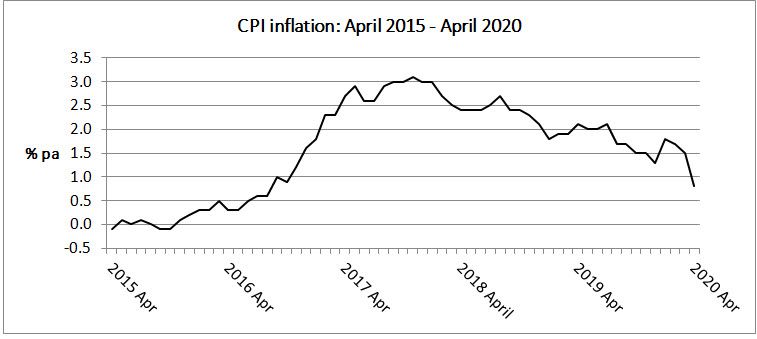
The disappearance of normal spending habits has created problems for the statisticians who calculate the rate of inflation.

Source: Office for National Statistics

Inflation, as measured by the Consumer Prices Index (CPI), fell sharply in April to just 0.9% against 1.5% in the previous month. The main reason for the drop was energy costs:

  • Ofgem’s new price caps for gas and electricity standard variable rate took effect in April and these were about 10% lower than the rates from April 2019. Even so, the bills set by the caps are generally much higher than those that can be found on any comparison website.
  • Petrol and diesel prices were also much reduced year on year – by 15.1p a litre for petrol and 17.0p a litre for diesel.

Missing items

In addition to the sharp moves in energy costs, there was also a serious problem with gathering the data. The Office for National Statistics (ONS) has an annually reviewed ‘shopping basket’ of goods and services which it uses to calculate the various inflation indices. However, for the latest numbers, the ONS discovered about 90 of the items in its basket – about one sixth of the total value – “were unavailable to consumers in the UK”. Haircuts, cinema tickets and a pint in a pub are just some of the many examples. Other items were theoretically available but in short supply, making the ONS’s price-tracking task more difficult – self-raising flour being a typical problem item. Ultimately the ONS was forced to “impute” (i.e. estimate) some prices.

Although some of the goods are still available, the restrictions on our movements mean they are no longer being bought. The ONS basket contains items which can be bought but are just being ignored in lockdown – many travel services fall into this category. For now, at least, the basket is not representative of historical spending patterns. We may find that creates problems in the long term, as inflation indices are widely used by government to adjust benefits, prices and tax allowances.

Inflation may be under 1% and somewhat distorted at present, but it has not gone away. Some economists fear that it could roar back because of all the borrowed money being pumped into the economy by the government. Others think a recession/depression will keep inflation in check. Either way, it still needs to be factored into your plans: £1 in April 2015 has only 92p of buying power today.

Calling time on the triple lock?

The state pension triple lock may not survive much longer.

The impact of Covid-19 on earnings could mean a change in the way that state pensions are increased in each year. If nothing is done, it could give pensioners a large income boost, but cost the government dearly.

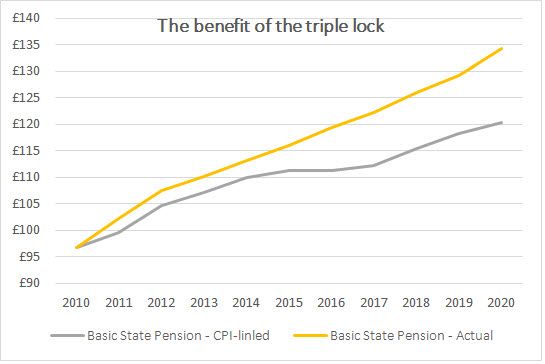
At present, the new (single tier) state pension and its predecessor, the basic state pension, both benefit from increases based on the ‘triple lock’. This was introduced by the Coalition government in 2010 and means that these two state pensions increase each April by the greater of:

  • yearly CPI inflation to the previous September;
  • average weekly earnings growth to the previous July; or
  • 2.5%.

This basis means that for 2021, the increase is likely to be 2.5% because CPI inflation will be lower (it was 0.5% in May) and earnings could well be falling due to the impact of furloughing.

It is in 2022 that a potential problem emerges for the Treasury. The furlough scheme ends at the end of October 2020, and if the economy starts to recover, by July 2021 earnings could be back to near ‘normal’. The fact that by then some of the formerly furloughed employees will be unemployed makes no difference to average earnings figures.

Economists reckon that the difference between ‘normal’ average earnings in July 2021 and furlough-depressed average earnings in July 2020 could be significant. In its Covid-19 ‘reference scenario’ the Office for Budget Responsibility has estimated earnings growth of over 18% in 2021 (against a 7.3% fall for 2020). No Chancellor would want to fund such a large rise in state pensions, not only because of the expense, but also on grounds of intergenerational fairness.

The Treasury and many economists have long argued that the triple lock is an unnecessary cost, but politicians have always been wary of upsetting an important section of the electorate. This additional problem now created by Covid-19 gives the government the best justification it is ever likely to have to dispense with the lock. There are even suggestions that state pensions could be frozen for the next two years until the issue (hopefully) disappears.

State pensions play an important role in many people’s retirement income planning, but their payment is ultimately a state decision, as evidenced by the many changes of recent years (for example to starting age). For that reason, if no other, private provision remains a vital component of your retirement planning.


Consumer credit Covid-19 measure extended

Help for consumers to manage their credit and debt has been extended to the end of October.

In mid-June, the Financial Conduct Authority (FCA) told firms to extend measures to provide help to people with credit cards, store cards, catalogue credit and personal loans who faced difficulties with their finances as a result of the Covid-19 crisis. This help was set to last initially for three months from April, but a recent update means there will now be a further three months’ flexibility ending on 31 October 2020.

Payment freeze

If you have already taken a payment freeze, you may now be able to take a further payment deferral or reduce payments to what you can afford. For anyone who has not yet requested a payment freeze, they can do so during the extended period.

A very important consideration is that you must still pay the debt back at the end of the deferral period, so there is potential to simply store up problems for a later date. With many people now returning to work, it makes sense to try to resume payments as soon as possible. It is at the discretion of the firm involved whether you will be charged interest during the payment freeze.

In theory, payment deferral should not affect your credit rating, but there is no guarantee that all loan providers will abide by this.

Overdrafts

Bank customers have been able to apply for an interest-free overdraft of up to £500. The interest-free period will now also run until 31 October 2020. Anyone who has not yet taken advantage of this measure has further time to do so. You can also request a lower rate of interest on borrowing in excess of the £500 interest-free buffer.

However, the FCA has not extended the temporary measure that meant overdraft customers were no worse off, with regards to their potential overdraft charges, than before April when a new temporary pricing structure for overdrafts was introduced. Although only a single rate of overdraft interest can now be charged, this can be around 40%.

The FCA provides detailed guidance on what Covid-19 means for your finances.